Guided Reading Activity Industrialization and Nationalism Chapter 10 Lesson 1
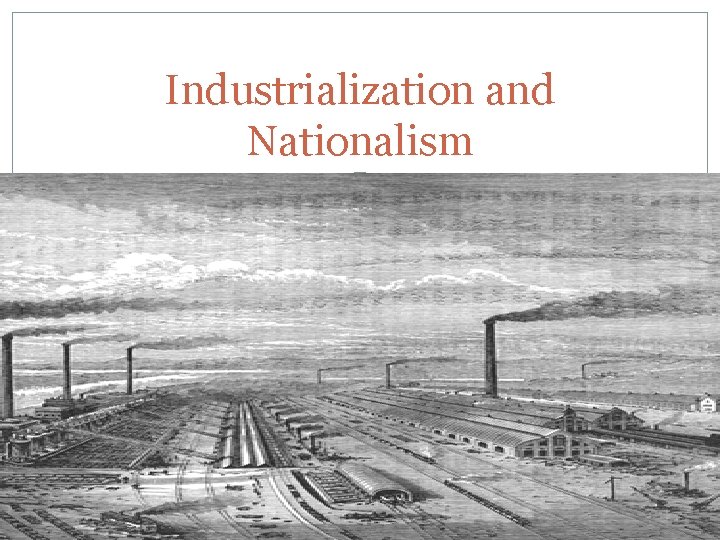
Industrialization and Nationalism Affiliate x LESSON 1

Objective �To sympathize the causes of the industrial revolution and its effects. �Question: What was the significance of the Agricultural Revolution in Great Britain? Why did the Industrial Revolution start in Great U.k.?

Bellringer �Dickens' Hard Times excerpt

Europe: 1800 - 1870


Industrial Revolution in Smashing U.k.

Industrial Revolution �**Began in Groovy Britain in 1780 due south** �5 factors contributed to making Great Uk the starting place.

Five Factors � 1) Agricultural Innovations: good weather, improved transportation, new crops such every bit the potato all increased the food supply thereby assuasive increasing the population � ii) Population Growth: with population growth, England had a larger labor force to piece of work the factories; also, **Parliament passed enclosure laws assuasive landowners to fence off country forcing peasants to move to town to discover work.

� iii) Capital (coin available for investment): United kingdom of great britain and northern ireland had money to invest in new machines and factories; � iv) Natural Resources: country's rivers provided ability to factories; abundance of coal and iron ore; � 5) Market place access: Britain was an empire with colonies; they had a demand both abroad and at home for manufactured goods.

Enclosure Motion of the 1700 south Enclosure laws allowed landowners to fence off land formerly used as common pasture. The map on the left shows a British farming area in 1700; the shaded areas are common pastures. The map on the right shows the same area in 1800, with the common pastures eliminated by fences.

Enclosure Move of the 1700 south Effects of enclosure laws: • Landowners fence in common lands. • Peasants move to towns to find work. • Factories do good from new labor supply. • Remaining farms are larger, with increased ingather yields.

Cotton wool Product and New Factories �Before the IR, making cotton wool cloth was normally done in rural cottages. �Fast forward to 1780 due south, weaving cloth was done in factories near rivers and streams, and so moved to cotton mills powered by the steam engine. �The steam engine, invented past James Watt, was a cardinal component to the Industrial Revolution.

The Factory �The factory became a new concept during the IR. �It created a new labor system; work was around the clock; information technology was monotonous and rote; kid labor was used.

Coal, Iron, and Railroads �**The steam engine relied on coal for power, which aided in the transformation of the iron industry. �**Puddling was adult; high-quality atomic number 26 industry expanded, creating new machines. �**Get-go steam locomotive was invented to movement appurtenances.

Inventions of the Industrial Revolution • • Puddling o Produced bar iron without hammering o Faster product of high quality iron Steam engine o Transformed transportation and agriculture o With James Watt's improvements, enabled to drive machinery


�Circle Nautical chart

Question Why did the Industrial Revolution start in Great United kingdom of great britain and northern ireland?

Review 1. The Agricultural Revolution increased the ____ supply, lowered ____ , and allowed ordinary people to spend money on manufactured appurtenances. 2. Inventions such as the _____ helped increase ____ material production dramatically, causing it to go U.k.'s nearly valuable product by 1840. 3. Coal and _______ industries boomed, and steam _______ helped move appurtenances faster and cheaper.

Video �Industrial Revolution

Guiding Question �What factors fed the spread of industrialization in both Europe and Northward America. ?

Spread showtime to countries whose governments were gear up for it: Belgium, France, Germany � Spread in America once population moved to cities from farms � Railway system was key factor in both Europe and The states �

The Spread of Industrialization �By mid 1800 southward, Corking United kingdom of great britain and northern ireland became the earth'southward first industrial nation; it also became the richest. �The Industrial Revolution spread to America. In 1800, five million people lived in the U. S. with 6 out 7 being farmers. By 1860, 30 one thousand thousand people lived in the U. S. and half were farmers.

U. S. Railroad �With the U. Southward. being such a large state, it had to develop a railroad arrangement to move the manufactured goods, which it did.

Social Impact of Industrialization �Urbanization: famine and poverty were the two big factors that forced people to migrate from the countryside into cities to work in factories. �The rapid growth of cities led to pitiful living atmospheric condition.

London 1850 � The London-route district, being the proper noun given to that portion of the boondocks under my direction, contains a population of almost xxx, 000. It is bounded upon 1 side throughout its whole grade (say the altitude of a mile and a half) by the river Medlock, a black filthy ditch, into which the inhabitants upon its borders or the diverse manufactories in its course, consisting of dye and chemical works, pour all their superabundant filth. Innumerable privies, connected with the dorsum of long terrace ranges of private dwellings, empty themselves into the aforementioned source; in fact, it is the eliminating aqueduct for all who can attain its banks to pour off every nuisance, liquid or solid. The opposing side of the district is bounded by the Rochdale Culvert, nearly throughout the same extent.

Social Classes �Industrial capitalism, an economic system based on industrial production or manufacturing, rose during the IR. �**This system produced a new middle-grade group – the industrial middle class. �**The IR too created the industrial working class that faced terrible working weather.

Conditions �Workday was effectually 12 – 16 hours; worked vi days a week. �No security of employment and no minimum wage. �Men, women, and children all worked in factories, cotton fiber mills, and coal mines.


�Child labor description


Review �What land was the world'southward first industrialized nation? �Why did so many people get out rural areas (in U.k.) and move to cities during the industrial revolution? �What was this concept called where people migrated from rural boondocks into the urban cities?

Objective �Students will be able to depict the working atmospheric condition of workers in the factory system. �Students will understand socialism and how the working conditions gave ascent to the socialist movement.

Factory Deed of 1833 �Passed in Britain in 1833. �**This Act was the beginning attempt at limiting child labor. �It stated: no child workers nether nine years of historic period; children of 9 -13 years to work no more than nine hours a twenty-four hour period; children of 13 -xviii years to work no more than 12 hours a twenty-four hours; children are non to work at night; two hours schooling each solar day for children

Extract from a Factory Inspector Report (1836) � My Lord, in the case of Taylor, Ibbotson & Co. I took the bear witness from the mouths of the boys themselves. They stated to me that they commenced working on Fri morning, the 27 thursday of May last, at six A. M. , and that, with the exception of meal hours and ane hour at midnight actress, they did not end working till four o'clock on Sabbatum evening, having been two days and a dark thus engaged. Believing the case scarcely possible, I asked every male child the same questions, and from each received the same answers. I and then went into the house to await at the time book, and in the presence of one of the masters, referred to the cruelty of the instance, and stated that I should certainly punish it with all the severity in my power. Mr. Rayner, the certificating surgeon of Bastile, was with me at the time.

Socialism �The terrible working atmospheric condition created by the industrial revolution led to socialism, a organization in which social club usually in the grade of the government, owns and controls means of product. �Socialism Video

Early Socialist Utopia Proposed design for Robert Ower's utopian community at New Harmony, Indiana

Early on Socialist Utopia Krupp factory in Essen, Germany

Early on Socialist Utopia What ideals were the early socialists striving for? • Wealth could be distributed evenly if government controlled factory production. • Everyone's basic needs—food, shelter, wear— would exist met. • Workers would be fulfilled by using their skills.

Review � Well-nigh important to the development of an effective American transportation organisation was the ______. � The Industrial Revolution spurred _____ , every bit people left the countryside in search of work. � 2 new social classes emerged during the Industrial Revolution: an industrial ____ class and an industrial _____ class that faced wretched working and living conditions. � The Mill Act of 1833 limited _____ labor. � In the economic arrangement of _______ , the regime controls the means of_______ , similar utilities and factories.


Crash Course �Industrial Revolution

Industrial Revolution Worksheet �Worksheet
Source: https://slidetodoc.com/industrialization-and-nationalism-chapter-10-lesson-1-objective/
0 Response to "Guided Reading Activity Industrialization and Nationalism Chapter 10 Lesson 1"
ارسال یک نظر